Environmental Research
How We Can Help You
Campbell Scientific soil water instrumentation is used extensively to monitor water content and matric potential in applications requiring knowledge of soil water inventory or movement. Our soil water instrumentation can be used to automatically monitor multiple probes for time-series information or make point measurements using a portable, hand-held system. Proven reliability, durability, low power use, accurate measurements, and the ability to customize each system make our data loggers and sensors ideal for a variety of applications including:
- Agricultural research
- Soil water content profiling
- Irrigation scheduling
- Slope stability
- Leak detection
- Greenhouse/horticultural
- Forestry
- Solute transport studies
- Watershed studies
- Greenhouse/horticultural
- Forestry
- Solute transport studies
- Watershed studies
Soil Science System Benefits
- Soil water sensors and systems use proven and innovative measurement methods.
- Versatility is inherent in all systems allowing expansion and custom configuration.
- System is compatible with other available sensors.
- Data loggers provide statistical and mathematical processing for on-site data management.
- Battery/solar power system supports long-term, remote operation.
- Our systems have proven reliability even in harsh environments.
- Communications options include satellite, phone, cellphone, and radio.
- Expert customer support ensures you get the correct measurement.
Data Loggers used in Soil Science
Our measurement systems are based around programmable data loggers that measure the sensors, then process, store, and transmit the data. We offer a family of reliable battery-powered data loggers that have wide operating temperature ranges and ample input channels for commonly used sensors. Our data loggers interface directly to most sensors, eliminating external signal conditioning. If needed, channel capacity can be expanded using multiplexers.
Our data loggers also feature programmable scan rates, measurement types, and recording intervals and provide onboard statistical and mathematical functions for on-site data management.
Sensors used in Soil Science Measurements
We can measure nearly every commercially available soil sensor, including tensiometers, heat flux plates, thermocouples, psychrometers, lysimeters, and gypsum blocks. See the 'Soil Water Content' and 'Soil Water Matric Potential' links above for more information about the quality sensors we manufacture.
Communications
The availability of multiple telecommunications and on-site options for retrieving data also allows systems to be customized to meet exact needs. Options include: voice-synthesized phone, telephone, cellphone, satellite, radio, ethernet, short haul, meteorburst, coaxial cable, and storage module. Systems can be programmed to send alarms or report site conditions by calling out to computers, phones, radios, or pagers. Real-time or historical data can be displayed or processed with Campbell Scientific software. Data can also be exported as ASCII files for further processing by spreadsheets, databases, or analysis programs.
Soil Water Content
We measure soil water content using methods that are sensitive to soil dielectric constant. Our TDR100-based system uses proven time-domain reflectometry (TDR) to accurately and reliably measure soil volumetric water content and bulk electrical conductivity in soils over a wide range of textures and soluble salt concentrations. This system uses coaxial multiplexers to connect the TDR100 to up to 512 TDR probes. The TDR100 features lower current demand and a typical measurement time of two seconds. The operating temperature range of -25° to +50°C covers typical applications as well as monitoring frost depth. Windows support software provides setup, troubleshooting, and display of waveforms and measurements. A customized 16" x 18" environmental enclosure is configured to easily mount and protect a CR1000 datalogger or CR3000 datalogger, 12 volt power supply, TDR100, and 8-channel multiplexer.
The CS616-L is a self-contained water content sensor that uses high-speed electronics in the body of the sensor to generate a square wave output with a period that is proportional to water content. Measurement of the square wave by a data logger's single-ended channel gives precise, high-resolution water content measurements in less than 0.1 seconds, even with long cables.
If you need a profile of the soil water content, the EasyAG and EnviroSMART sensors are an ideal solution to measure soil moisture at multiple depths. Easy to install, the probes have a measurement range from oven dry to saturation. Integrating the probes into a data acquisition system allows the data to be telemetered back to a field station or remote computer.
For portable volumetric water content measurements, the hand-held HydroSense® consists of a probe and output display. It can be easily carried from site to site and provides immediate soil water content readings. Low power requirements and fast measurement times provide thousands of measurements, powered only by 2 AA batteries.
Soil Water Matric Potential
Sensors from Campbell Scientific that measure soil water matric potential use heat dissipation and electrical resistance methods. The 229-L Matric Potential Sensor covers a water potential range from -10 J/kg to -104 J/kg by using the temperature response of a heating element embedded in a ceramic matrix. A constant current source is available for reliable and precise heating. Sixteen 229-L sensors are easily multiplexed to a single data logger differential input channel using the AM16/32 multiplexer. Watermark and Delmhorst electrical resistance sensors provide an inexpensive method of measuring smaller matric potential ranges.
Products
Browse All ProductsMore Details
Data Loggers
At the core of our systems is a programmable data logger that measures the sensors, then processes, stores, and transmits the data. These data loggers have programmable execution intervals, wide operating temperature ranges, and on-board instructions for commonly used sensors. If needed, channel capacity can be expanded using multiplexers.
Data are typically displayed and stored in the units of your choice (e.g., wind speed in mph, m/s, knots). Measurement processing and data storage are programmable, but measurements are typically made every minute then processed and stored at hourly and daily intervals (e.g., maximum, minimum, average). Data can be measured and stored more or less frequently (depending on the application and conditional sampling) based on events such as increased wind speeds, torrential rainfall, or diurnal cycle.
Battery power and solar power allow our data loggers to provide remote, unattended data collection over long periods of time. Our instrumentation has been proven in some of the harshest environments in the world.
PC-based software is customized to simplify data logger programming, data retrieval, and report generation. The data logger program can be modified at any time to accommodate different sensor configurations or data processing requirements.
Sensors
Almost any sensor can be measured by our data loggers, allowing monitoring systems to be customized for each site. Typical sensors used on our stations include, but are not limited to: wind speed, wind direction, solar radiation of various types, air temperature, water temperature, soil temperature, relative humidity, precipitation, snow depth, barometric pressure, soil moisture, soil electrical conductivity, and soil heat flux. Our systems interface to a variety of sensors that measure water level and water flow, as well as water quality parameters such as pH, conductivity, and dissolved oxygen. Our data loggers can interface directly to most air flow sensors, opacity meters, particle samplers, and gas analyzers.
Communications
We offer multiple communications options for data retrieval, allowing monitoring systems to meet specific application requirements. On-site data retrieval options include storage module, laptop computer, PDA, and data logger keyboard/display. Telecommunication options include short-haul, voice synthesized telephone, cellular telephone, radio frequency, multidrop, and satellite. Options can be mixed within the same network. Robust error-checking and low power-use ensure your data arrives uncorrupted and as scheduled. You can even automate the process of putting your data on the Internet.
Case Studies
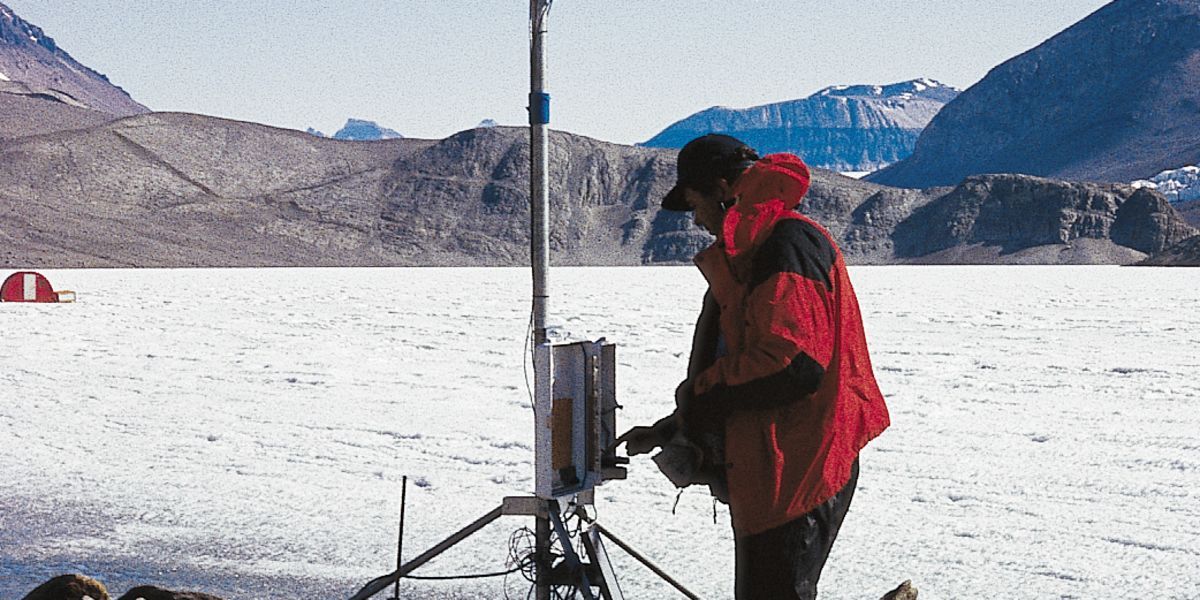
Antarctica: Dry Valley Ecosystems
Monitoring one of Earth’s most extreme deserts
Greenland: Ecosystem Monitoring Program
Monitoring the dynamics of a high arctic ecosystem
Norway: Airport Groundwater Quality
Protecting water supplies from deicing chemicals and jet fuel
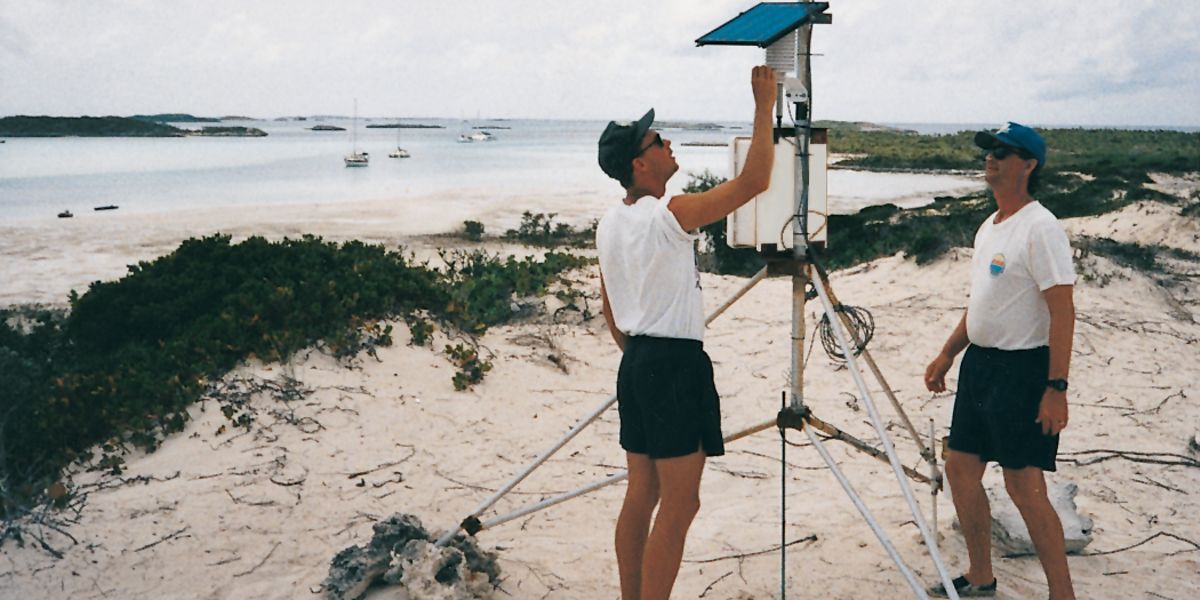
Monitoring vital weather patterns in the Caribbean