CS650

CS650
Orderable30 cm Soil Moisture and Temperature Sensor
Configuration
- w/3m (10 ft) per CableCS650-3mPart Number: 45369-3m
- w/5m (17 ft) per CableCS650-5mPart Number: 45369-5m
- w/10m (33 ft) per CableCS650-10mPart Number: 45369-10m
- w/15m (50 ft) per CableCS650-15mPart Number: 45369-15m
Select a configuration to add to your quote
- Model:
- CS650
- Item Number:
- 45369
- Warranty:
- 1 year
Overview
The CS650 is a multiparameter smart sensor that uses innovative techniques to monitor soil volumetric water content, bulk electrical conductivity, and temperature. It outputs an SDI-12 signal that many of our data loggers can measure.
Note: The cable termination options for this sensor are not suitable for use with an ET107 station. For this type of station, use the CS650-LC sensor instead, which has a suitable cable connector.
Key Advantages
More accurate in soils with high bulk electrical conductivity
Technical Description
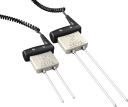
The CS650 consists of two 30-cm-long stainless steel rods connected to a printed circuit board. The circuit board is encapsulated in epoxy and a shielded cable is attached to the circuit board for data logger connection.
The CS650 measures propagation time, signal attenuation, and temperature. Dielectric permittivity, volumetric water content, and bulk electrical conductivity are then derived from these raw values.
Measured signal attenuation is used to correct for the loss effect on reflection detection and thus propagation time measurement. This loss-effect correction allows accurate water content measurements in soils with bulk EC ≤3 dS m-1 without performing a soil specific calibration.
Soil bulk electrical conductivity is also calculated from the attenuation measurement. A thermistor in thermal contact with a probe rod near the epoxy surface measures temperature. Horizontal installation of the sensor provides accurate soil temperature measurement at the same depth as the water content. Temperature measurement in other orientations will be that of the region near the rod entrance into the epoxy body.
Benefits
- More accurate water content measurements in soils with bulk EC up to 3 dS m<sup>-1</sup> without performing a soil-specific calibration
- Larger sample volume reduces error
- Measurement corrected for effects of soil texture and electrical conductivity
- Estimates soil-water content for a wide range of mineral soils
- Versatile sensor—measures dielectric permittivity, bulk electrical conductivity (EC), and soil temperature
Specifications
- Measurements Made
- Soil electrical conductivity (EC), relative dielectric permittivity, volumetric water content (VWC), soil temperature
- Required Equipment
- Measurement system
- Soil Suitability
- Long rods with large sensing volume (> 6 L) are suitable for soils with low to moderate electrical conductivity.
- Rods
- Not replaceable
- Sensors
- Not interchangeable
- Sensing Volume
- 7800 cm3
(~7.5 cm radius around each probe rod and 4.5 cm beyond the end of the rods)
- Electromagnetic
- CE compliant
Meets EN61326 requirements for protection against electrostatic discharge and surge. - Operating Temperature Range
- -50° to +70°C
- Sensor Output
- SDI-12; serial RS-232
- Warm-up Time
- 3 s
- Measurement Time
- 3 ms to measure; 600 ms to complete SDI-12 command
- Power Supply Requirements
- 6 to 18 Vdc
(Must be able to supply 45 mA @ 12 Vdc.)
- Maximum Cable Length
- 610 m
(2000 ft) combined length for up to 25 sensors connected to the same data logger control port
- Rod Spacing
- 32 mm
(1.3 in.)
- Ingress Protection Rating
- IP68
- Rod Diameter
- 3.2 mm
(0.13 in.)
- Rod Length
- 300 mm
(11.8 in.)
- Probe Head Dimensions
- 85 x 63 x 18 mm
(3.3 x 2.5 x 0.7 in.)
- Cable Weight
- 35 g per m
(0.38 oz per ft)
- Probe Weight
- 280 g
(9.9 oz) without cable
Current Drain
- Active (3 ms)
- 45 mA typical
(@ 12 Vdc)
80 mA(@ 6 Vdc)
35 mA(@ 18 Vdc)
- Quiescent
- 135 µA typical
(@ 12 Vdc)
Electrical Conductivity
- Range for Solution EC
- 0 to 3 dS/m
- Range for Bulk EC
- 0 to 3 dS/m
- Accuracy
- ±(5% of reading + 0.05 dS/m)
- Precision
- 0.5% of BEC
Relative Dielectric Permittivity
- Range
- 1 to 81
- Accuracy
- ±(2% of reading + 0.6)
from 1 to 40 for solution EC ≤ 3 dS/m
±1.4(from 40 to 81 for solution EC ≤1 dS/m)
- Precision
- < 0.02
Volumetric Water Content
- Range
- 0 to 100%
(with M4 command)
- Water Content Accuracy
- ±1%
(with soil-specific calibration)
±3%(typical with factory VWC model) where solution EC < 3 dS/m
- Precision
- < 0.05%
Soil Temperature
- Range
- -50° to +70°C
- Resolution
- 0.001°C
- Accuracy
- ±0.1°C
(for typical soil temperatures [0 to 40°C] when probe body is buried in soil)
±0.5°C(for full temperature range)
- Precision
- ±0.02°C
Accessories
(6)CS650G
Rod Insertion Guide Tool
OrderableA200
Sensor to PC Interface
Orderable33815
SDI-12 Terminal Bus Kit
Orderable39121
DIN Rail Terminal Kit with 2 Terminals and 5 Wires
Orderable39642
SDI-12 DIN Rail Terminal Bus Kit without Mounting Bracket
OrderableA151
Single Sensor Terminal Case, Vented with Desiccant
Orderable
Common Accessories
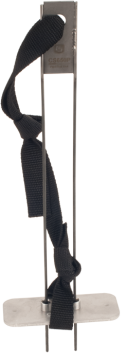
(5)CS650G
Rod Insertion Guide Tool
The CS650G makes inserting soil-water sensors easier in dense or rocky soils. This tool can be hammered into the soil with force that might damage the sensor if the CS650G were not used. It makes pilot holes into which the rods of the sensors can then be inserted.
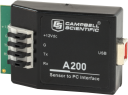
OrderableA200
Sensor to PC Interface
The A200 allows the probe to be connected to a computer for changing the SDI-12 address or updating the operating system.
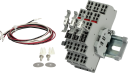
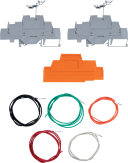
Orderable39121
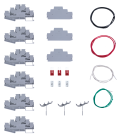
DIN Rail Terminal Kit with 2 Terminals and 5 Wires
The 39121 provides the needed DIN rail terminals, separator, and wires to connect any product to a data logger or other peripheral that requires five wires for connection. This kit provides the following wires: black, green, orange, red, and clear. The color-coding of these wires matches the wire coloring of the product for ease in connection, maintenance, and troubleshooting.
Orderable39642
SDI-12 DIN Rail Terminal Bus Kit without Mounting Bracket
The 39642 makes it easier for you to connect wires from multiple SDI-12 sensors into one set of terminals on a data logger. The 39642 uses six DIN-rail mountable (pn 27479), 6-wire terminal blocks. The 39642 is a jumper that electrically connects two terminal blocks together at a time (pn 32918). This setup allows up to 11 SDI-12 sensors to be connected to one set of terminals on a data logger.
OrderableA151
Single Sensor Terminal Case, Vented with Desiccant
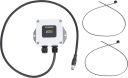
The A151 is a vented junction box with terminal blocks to connect sensors to an M12 eight-pin connector. It has accessories to allow the use of various lengths of cable and termination options.
Orderable
Other Accessories
(4)15920
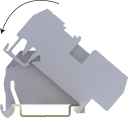
DIN Rail Mountable 3-Wire 4 mm Spring-Loaded Connector
The 15920 is a DIN-rail mountable terminal connector that can be used between sensors (or other devices) and a datalogger. The 15920 is a three-wire, 4-mm spring-loaded connector.
Orderable15909
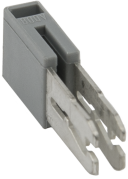
Horizontal Jumper for DIN Rail Connector
The 15909 jumper electrically connects terminals on the 15920 connectors (see above).
Orderable15907
End Plate/Separator for DIN Rail Connector
The 15907 End Plates separate the 15920 connectors.
Orderable33815
SDI-12 Terminal Bus Kit
The 33815 makes it easier for you to connect wires from multiple SDI-12 sensors into one set of terminals on a data logger. The 33815 uses six DIN-rail mountable (pn 27479) 6-wire terminal blocks. The 33815 jumpers two connectors together at a time (pn 32918). This setup allows up to 11 SDI-12 sensors to be connected to one set of terminals on a data logger.
Orderable
Similar Products
(6)CS655
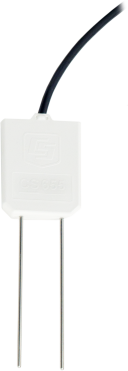
12 cm Soil Moisture and Temperature Sensor
OrderableCS616
30 cm Water Content Reflectometer
OrderableHS2
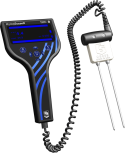
HydroSense II Handheld Soil Moisture Sensor
OrderableCS658
HydroSense II Water Content Sensor with 20 cm Rods
OrderableCS659
Water Content Sensor for HydroSense II with 12 cm Rods
OrderableSoilVue 10
TDR Soil Moisture and Temperature Profile Sensor
Orderable

Compatibility
RF Considerations
External RF Sources
External RF sources can affect the probe’s operation. Therefore, the probe should be located away from significant sources of RF such as ac power lines and motors.
Interprobe Interference
Multiple CS650 sensors can be installed within 4 inches of each other when using the standard data logger SDI-12 “M” command. The SDI-12 “M” command allows only one probe to be enabled at a time.
Installation Tool
The CS650G makes inserting soil-water sensors easier in dense or rocky soils. This tool can be hammered into the soil with force that might damage the sensor if the CS650G were not used. It makes pilot holes into which the rods of the sensors can then be inserted.
Related Resources
Case Studies
Documents
- Manual
SDI-12 Terminal Bus Kit Getting Started Guide
May 2026
View Document - Technical Paper
Soil-specific calibration procedure for volumetric water content sensors
January 2021
View Document - Brochure
CS650 and CS655 Soil Water Content Reflectometer
September 2011
View Document - Manual
CS650 and CS655 Water Content Reflectometers
July 2025
View Document
Showing 4 of 9 results
See all DocumentsDownloads
Videos and Tutorials
SDI-12 Sensors | Transparent Mode
November 27, 2013 (7:06)
Communicating with an SDI-12 sensor
Watch
SDI-12 Sensors | Watch or Sniffer Mode
November 27, 2013 (3:20)
Watching communication between an SDI-12 sensor and a datalogger
Watch
CRBasic | Advanced Programming
July 30, 2014 (6:50)
Programming multiple measurements of the same type
Watch
Measuring Water in the Soil: A Webinar
January 21, 2021 (32:06)
Common theories for making measurements of soil water content
Watch
Showing 4 of 7 results
See all Videos and Tutorials