CS625
CS625
RetiredWater Content Reflectometer for CR200(X)-Series and CR300-Series
No longer available to order
This product is retained for service, documentation, and compatibility information.
- Model:
- CS625
- Item Number:
- 15509
- Warranty:
- 1 year
Overview
The CS625 measures the volumetric water content from 0% to saturation. It is similar to our CS616 but is designed specifically for CR200(X) and CR300-series dataloggers. This reflectometer has a 0 to 3.3 V square wave frequency output that our CR300-series and CR200(X)-series dataloggers can measure.
Key Advantages
Designed for long-term monitoring
Technical Description
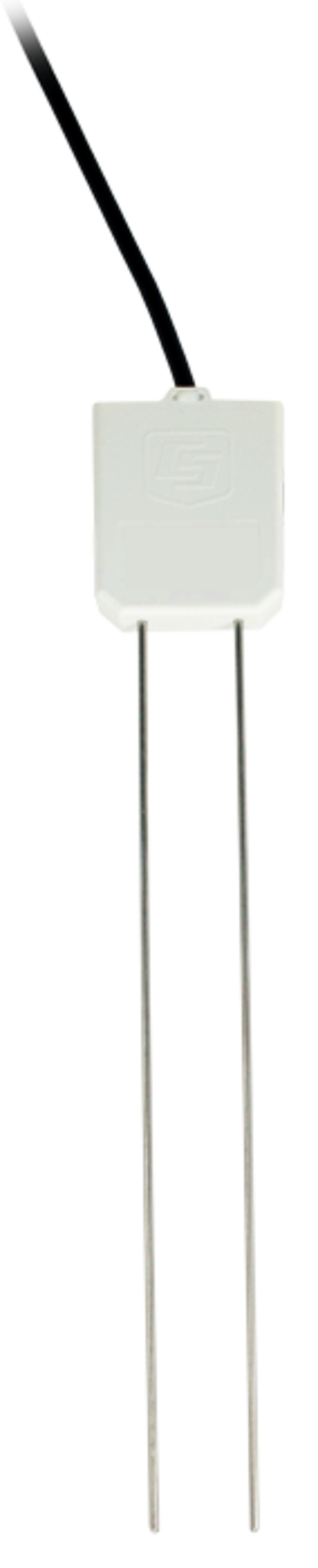
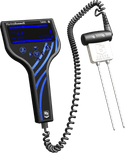
The CS625 consists of two 30-cm-long stainless steel rods connected to a printed circuit board. The circuit board is encapsulated in epoxy, and a shielded four-conductor cable is connected to the circuit board to supply power, enable probe, and monitor the output.
The CS625 measures the volumetric water content of porous media (such as soil) using the time-domain measurement method; a reflectometer (cable tester) such as the TDR100 is not required. This method consists of the CS625 generating an electromagnetic pulse. The elapsed travel time and pulse reflection are then measured and used to calculate soil volumetric water content.
Response Characteristics
The signal propagating along the parallel rods of the CS625 is attenuated by free ions in the soil solution and conductive constituents of the soil mineral fraction. In most applications, the attenuation is not enough to affect the CS625 response to changing water content, and the response is well described by the standard calibration. However, in soil with relatively high soil electrical conductivity levels, compacted soils, or soils with high clay content, the calibration should be adjusted for the specific medium. Guidance for making these adjustments is provided in the operating manual.
Benefits
- High accuracy and high precision
- Fast response time
- Designed for long-term unattended water content monitoring
- Probe rods can be inserted from the surface or buried at any orientation to the surface.
Specifications
- Measurements Made
- Volumetric water content of porous media (such as soil)
- Water Content Accuracy
- ±2.5% VWC
(using standard calibration with bulk EC of ≤ 0.5 dS m-1, bulk density of ≤ 1.55 g cm-3, and measurement range of 0% to 50% VWC)
- Required Equipment
- Measurement system
- Soil Suitability
- Long rods and lower frequency are well-suited for soft soil with low electrical conductivity (< 2 dS/m).
- Rods
- Not replaceable
- Sensors
- Not interchangeable
- Operating Temperature Range
- 0° to 70°C
- Probe-to-Probe Variability
- ±0.5% VWC in dry soil, ±1.5% VWC in typical saturated soil
- Precision
- 0.1% VWC
- Resolution
- 0.1% VWC
- Output
- 0 to 3.3 V square wave
(with frequency dependent on water content)
- Current Drain
- 65 mA @ 12 Vdc
(when enabled)
45 μA(quiescent typical)
- Power Supply Voltage
- 5 Vdc minimum; 18 Vdc maximum
- Enable Voltage
- 4 Vdc minimum; 18 Vdc maximum
- Electromagnetic
- CE compliant
(Meets EN61326 requirements for protection against electrostatic discharge.)
- Rod Spacing
- 32 mm
(1.3 in.)
- Rod Diameter
- 3.2 mm
(0.13 in.)
- Rod Length
- 300 mm
(11.8 in.)
- Probe Head Dimensions
- 85 x 63 x 18 mm
(3.3 x 2.5 x 0.7 in.)
- Cable Weight
- 35 g per m
(0.38 oz per ft)
- Weight
- 280 g
(9.9 oz) without cable


Compatibility
Note: The following shows notable compatibility information. It is not a comprehensive list of all compatible or incompatible products.
RF Considerations
The RF emissions are below FCC and EU limits as specified in EN61326 if the CS625 is enabled less than 0.6 ms, and measurements are made less frequently than once a second. External RF sources can also affect the CS625 operation. Consequently, the CS625 should be located away from significant sources of RF such as ac power lines and motors.
Installation Tool
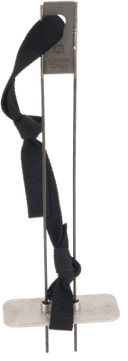
The CS650G makes inserting soil-water sensors easier in dense or rocky soils. This tool can be hammered into the soil with force that might damage the sensor if the CS650G were not used. It makes pilot holes into which the rods of the sensors can then be inserted. It replaces both the 14383 and 14384.
Data Logger Considerations
Each CS625 requires a single-ended input channel. A control port is used to enable one or more probes.
Note: A maximum of four CS625 probes can be measured by one CR200(X) datalogger. Valid channel options are analog channels 1 through 4.
Compatible Products
(11)
CR200X
Datalogger
RetiredNotes—
CR206X
Datalogger with 900 MHz Spread-Spectrum Radio
RetiredNotes—
CR211X
Datalogger with 922 MHz Spread-Spectrum Radio
End of lifeNotes—
CR216X
Datalogger with 2.4 GHz Spread-Spectrum Radio
RetiredNotes—
CR295X
Datalogger for GOES Satellite Communication
RetiredNotes—
CR300
Measurement and Control Datalogger
RetiredNotes—
CR310
Measurement and Control Datalogger
OrderableNotes—
CR800
Measurement and Control Datalogger
RetiredNotes—
CR850
Measurement and Control Datalogger
RetiredNotes—
CR1000
Measurement and Control Datalogger
RetiredNotes—
CR3000
Measurement and Control Datalogger
RetiredNotes—
Related Resources
Product Life Events
- Available for Order
- February 8, 2016
- Calibration Available Until
- December 31, 2017
- Retired
- December 31, 2017
- Free Support Until
- December 31, 2027
- End of Life
- December 31, 2027
- Repair Available Until
- December 31, 2027